|
METODORF.COM
Interactive Portal-Book of Self-Development Methods
|
||||||||||
Stroop Test Online: Free Interactive Cognitive Flexibility TestTake a free, interactive Stroop test online to measure your cognitive flexibility. Get instant results with our classic, verbal, and game-style versions. 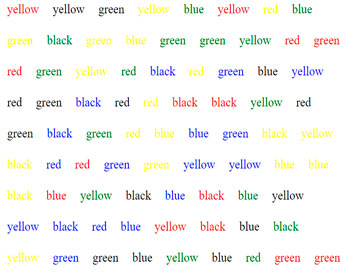 Content of the article: ▼ What is the Stroop effect ▼ Stroop test online classic version ▼ Stroop Test Online Verbal Version (with microphone) ▼ Modified Stroop test - search for color and name matches ▼ Stroop test - Not or Yes - experimental version ▼ Emotional Stroop Test ▼ Interpretation of stroop test results The Stroop test (also known as the color-word test) is based on the well-known Stroop effect, a psychological phenomenon where a person experiences difficulty naming the color of a word if the word itself spells out a different color. For example, if the word "black" is printed in red ink, a person will momentarily hesitate—often without realizing it—before correctly identifying the ink color. This hesitation means it takes longer to name the color compared to when the word meaning matches the ink color (e.g., "red" printed in red). Interestingly, this effect only occurs if you understand the language the word is written in. According to unverified reports, counterintelligence agencies during the Cold War used this effect to identify spies. A person who knows the language will hesitate when naming the ink color of conflicting words. The degree of hesitation varies from person to person and depends on cognitive flexibility—which is precisely what the Stroop test measures. In its original form, the test is like an exam. You are given a form with a list of words—color names printed in mismatched ink colors. Your task is to quickly and accurately name the ink color, ignoring what the word actually says. Below, I offer several versions of the Stroop test to assess your cognitive flexibility: the classic non-verbal version (no speaking required), and a modified version where you must find 20 color words that match their ink color among 80 mismatched words—all within 1 minute. Stroop effectThe Stroop effect is a psychological phenomenon characterized by a delay in reaction time when a person is asked to name the color of a word that spells out a different color name. Named after John Ridley Stroop, a renowned American psychologist who researched cognitive processes and interference, this effect demonstrates how conflicting information can disrupt our automatic processing. The delay—the time it takes to override the automatic tendency to read the word—varies from person to person and can be measured experimentally. The speed at which someone correctly names the ink color of mismatched words, compared to matched words, reveals their level of cognitive rigidity or flexibility. A test based on the Stroop effect helps assess how easily a person can shift their conceptual framework when new information is presented, which reflects the flexibility of cognitive control and the automation of verbal and sensory-perceptual functions. The Stroop testThe classic Stroop test requires the participant to look at cards displaying color words printed in various ink colors. The goal is to name the ink color as quickly and accurately as possible, ignoring the written word. The test is divided into three stages:
The classic Stroop test on this site is presented in two-stage versions. In the first version (combining stages 1 and 2), you must correctly pronounce the color name, ignoring the word. In the second version (combining stages 2 and 3), you must name the ink color of the displayed words. The average time taken to correctly name colors in each stage is calculated. The difference in time between the conflicting stage and the control stage—divided by the number of items—gives the average delay per word. This delay is used to assess your cognitive flexibility or rigidity. Express Stroop test for 30 word-color pairs (standard is 100) in each of 2 series: Classical Stroop test online - Third version (2X30) Classical test - select color name by control text color Classical Stroop test online - Second variant (2X30) Select color name by control block or text color Classical Stroop test online - First variant (2X30) Select color by what color is named Stroop Test Verbal VersionThis version follows the classic format but instead of pressing buttons, you speak the color name into a microphone—just like in professional, lab-administered Stroop tests. For best results, use Google Chrome or Edge browser. This test evaluates your ability to concentrate and suppress automatic responses. It consists of three stages: 1. Neutral WordsName the ink color of the words (e.g., «house» → say "blue"). 2. Matching NamesWords match their ink color (e.g., «red» → say "red"). 3. Conflicting NamesWords mismatch their ink color (e.g., «green» → say "yellow").
Your task: Stroop Test online Verbal Version: Take the Stroop Test in conditions close to professional. Connect and configure your microphone. Allow microphone access in the browser after clicking the "Enable Microphone" button on the test page. Activate the speech recognition system and start the test. Words written in different colors will appear, and your task is to name these colors loudly and clearly. Stroop Test Verbal Version (pronouncing color through microphone) 30 words 4 colorsModified Stroop test based on the Stroop effectA test to measure how quickly you can identify correctly matched color words among mismatched ones.Test description. In this version, you are presented with a table of 100 color words printed in various ink colors. Among these 100 words, you need to find and highlight the 20 words whose ink color matches their meaning. Speed is critical, as the test lasts only 1 minute. That gives you about 0.6 seconds (600 milliseconds) per word to decide if they match. This test helps determine whether your mental flexibility allows you to complete the task within the time limit. For more accurate results, it's best to take the test multiple times—the correct matches are randomly placed among the incorrect ones each time. Clicking the test links will take you to a page with a form containing multicolored words. There are four test types using four colors: 1st (red, yellow, blue, black), 2nd (green, yellow, blue, black), 3rd (red, yellow, green, black), and 4th (red, green, blue, black). There is also a test with five colors (red, yellow, blue, black, green). These variations accommodate people with different color perceptions—for example, those who have difficulty distinguishing red, green, or blue but still want to assess their cognitive flexibility. Instructions: Your task is to mark the words (color names) on the form as quickly as possible where the ink color matches the word's meaning. For example, if the word "red" is printed in red ink, click on it. If the color and word don't match, just skip it. You have 1 minute. Pass the Stroop test based on the Stroop effect (Stroop effect is not calculated): Modified Stroop test (5 colors) Modified Stroop test (4 colors without red) Modified Stroop test (4 colors without green) Modified Stroop test (4 colors without blue) Modified Stroop test (4 colors without yellow) Stroop Test - Not or YesThis is an experimental online method for testing the Stroop effect. Your task is to quickly and accurately determine whether the color named by the control word matches the actual ink color of the test word. Respond "Yes" (right arrow →) if they match, or "No" (left arrow ←) if they do not. The test consists of two parts: the first uses congruent stimuli (the ink color matches the word's meaning), while the second uses incongruent stimuli (they differ). Two difficulty levels are available: simple (control word in white) and advanced (control word in random colors). Upon completion, you will receive detailed response statistics, the Stroop effect value (the difference in reaction time between phases), and an analysis of the most challenging tasks. Respond as quickly and honestly as possible—this ensures accurate results for assessing your cognitive flexibility. 4 colors 50 words standard version
4 colors 100 words standard version
4 colors 50 words advanced version
4 colors 100 words advanced version
Emotional Stroop TestThe Stroop test can do more than just measure how we name colors—it can also assess our emotional reactions to certain words. The emotional Stroop test reveals which words cause difficulty for participants when naming their color. This can be valuable in psychotherapy to identify emotional "trigger" words that momentarily distract a person from the task, causing a delay before they can name the color. Our website features an emotional Stroop test builder that allows you to customize the test by selecting words to uncover your own emotional responses or those of your patients. The test is completely anonymous; the list of words you use is stored only in your browser. Stroop Test Results: Key Metrics and Interpretation1. Stroop Effect (Interference)Calculated as the difference in completion time between incongruent and congruent conditions: Stroop Effect = Time(incongruent) - Time(congruent) | Note that when calculating Stroop test results, the metrics for each condition are summed and averaged, making it essential to maintain maximum focus during the test to prevent outliers from skewing the overall results.
2. Response Accuracy
Clinical interpretation of the Stroop testNeurological Disorders
Psychiatric ConditionsCharacteristic patterns across disorders:
Final words about the Stroop testStroop test interpretation requires a holistic approach considering age, education, and subject's general state. Results are valuable for:
Important: The Stroop test is not a standalone diagnostic tool but should be used within comprehensive neuropsychological evaluation. Additionally, administering multiple Stroop test variants is recommended for more precise effect measurement. Examples of test forms based on the Stroop effect: 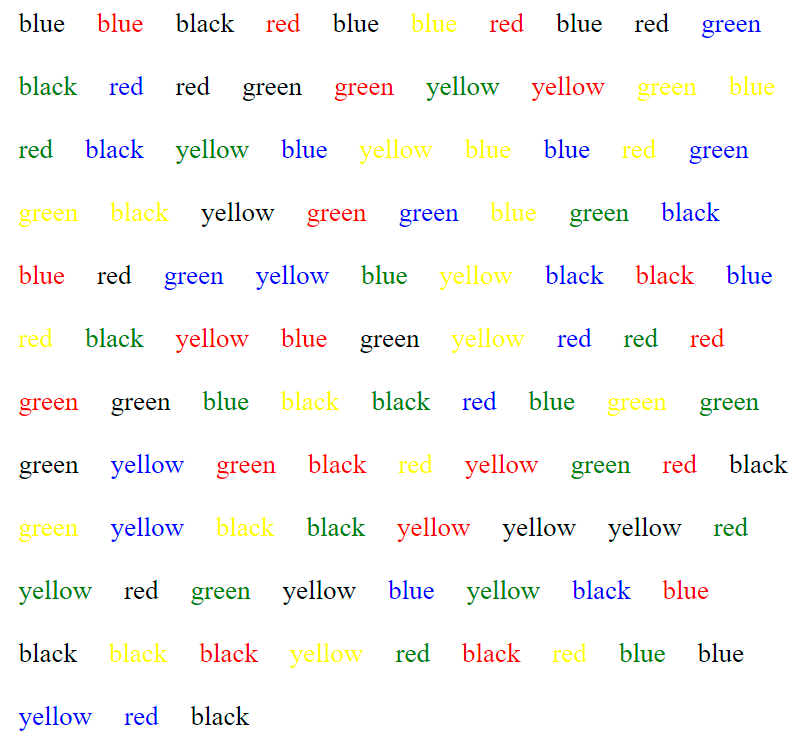 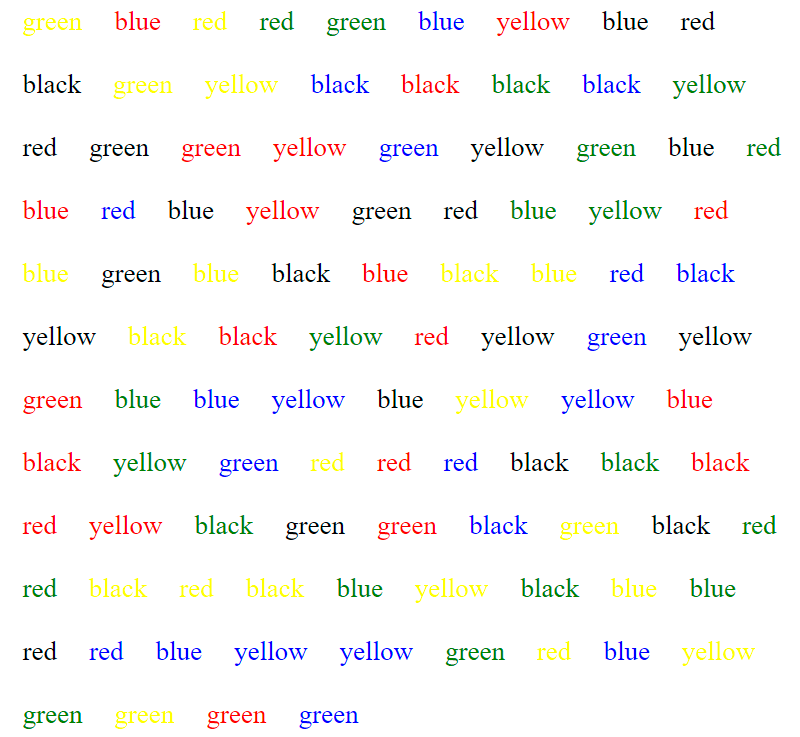 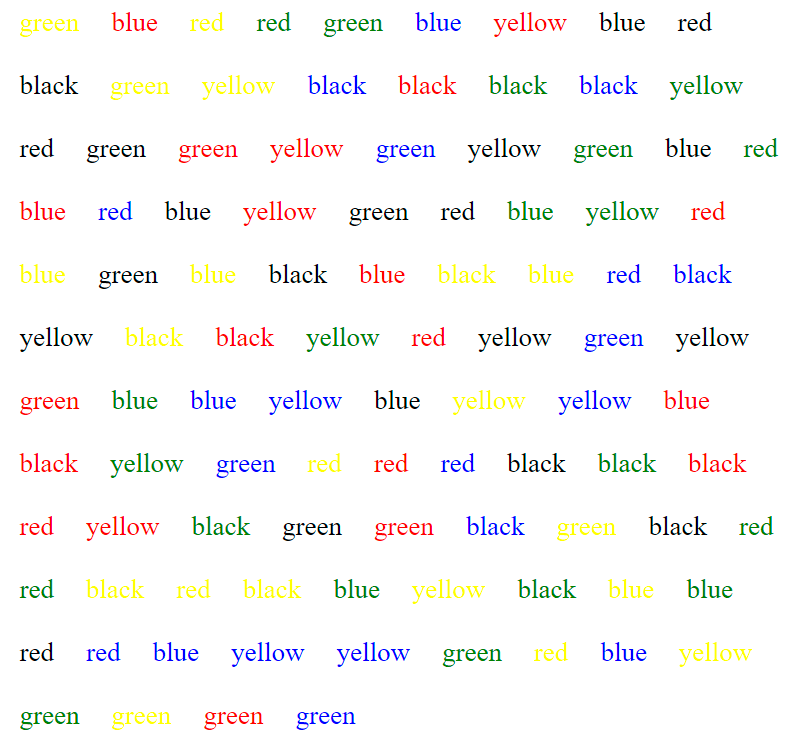 © Oleg Akvan metodorf.com Comment block
Shreya Prashant Chavan
2024-03-07 17:44:56
This test is useful
Лю Мань
2024-04-15 10:48:20
This test is uesful
Damon
2024-09-08 14:40:40
Wish I`d worn my glasses.
Damon
2024-09-08 14:42:30
Better this time
Damon
2024-09-08 14:44:09
Getting better
Damon
2024-09-08 14:48:50
I`ll take this one...
Damon
2024-09-08 15:11:04
Finally
Bella
2024-10-15 22:18:45
My result is below normal :( this time. I`ll build on it!
Vijayabanu
2024-12-16 08:41:23
Online version is very much useful for my students in cognitive lab
Gary
2025-01-05 21:06:27
Result 17
Surbhi Gupta
2025-09-09 12:20:48 Nice test Leave a comment:
Weekly Games & Trainers Collection: Advertisement:
|
||||||||||

© 2014 - 2026 Oleg Akvan metodorf.com
All rights reserved!
All rights reserved!